

 chicken egg
A Southern Thai and Malay meeting point
Pattani records the name khanom kata yap, while a Satun record uses khanom ta yap and associates the spelling with a name used across the Malaysian border. The roll fits local tea tables and appears in community food records and gatherings. Availability differs by shop and locality. A colourful soft wrapper and sweet coconut centre are easy visual cues.
The wrapper and filling
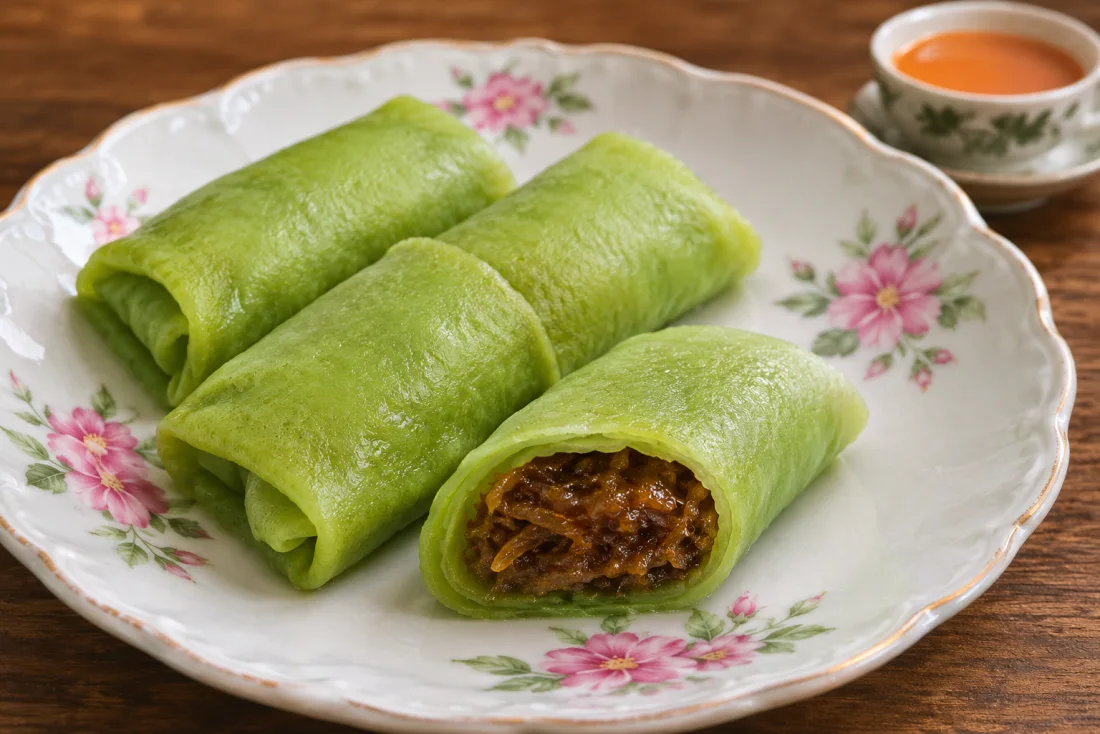
Pattani’s preparation uses rice flour, egg and pandan juice for a thin pancake. One Satun preparation uses wheat flour with glutinous rice flour, egg and pandan. Grated coconut cooks with brown or palmyra palm sugar to make a moist filling. The wrapper is cooked on a flat pan, then rolled around that filling. Some Satun makers use butterfly pea for a purple wrapper.
Colour and texture
Pandan gives a gentle green and a leafy fragrance; the purple version is a natural colour option. The sheet is thin and soft. Inside, the coconut stays moist, with a little fibre and fragrant cooked sugar. A warm cup of tea complements the sweetness. Storage and warmth can change how supple the sheet feels.
Two finished servings
One Pattani-style dish shows a few green wraps with a cut edge revealing brown grated coconut. Another shows green and light purple Satun-style wrappers around the same style of filling. Handmade rolls can leave a visible seam. They can be served in a small group on a plate, or shared one at a time.
Finding a roll at the market
Ask if the shop uses pandan or serves other colours, and whether the rolls were made today. A shop may use rice or a wheat blend, and sugar can vary. Pattani records mention milk tea as one accompaniment, and a plain tea can be ordered separately. Colours alone do not identify the batter or sugar.
Allergens and shared equipment
Both documented batters include egg. One Satun recipe has wheat, while the Pattani version uses rice flour. Ask about the actual batter and shared griddle when avoiding wheat. The filling contains coconut, and a milk tea pairing may contain dairy. Shared bowls, spatulas and dishes may contact other allergens. Plant-derived colour does not tell you how the shop handles ingredients.
If you have a food allergy, tell the restaurant before ordering and ask about ingredients, sauces and shared cooking equipment.