
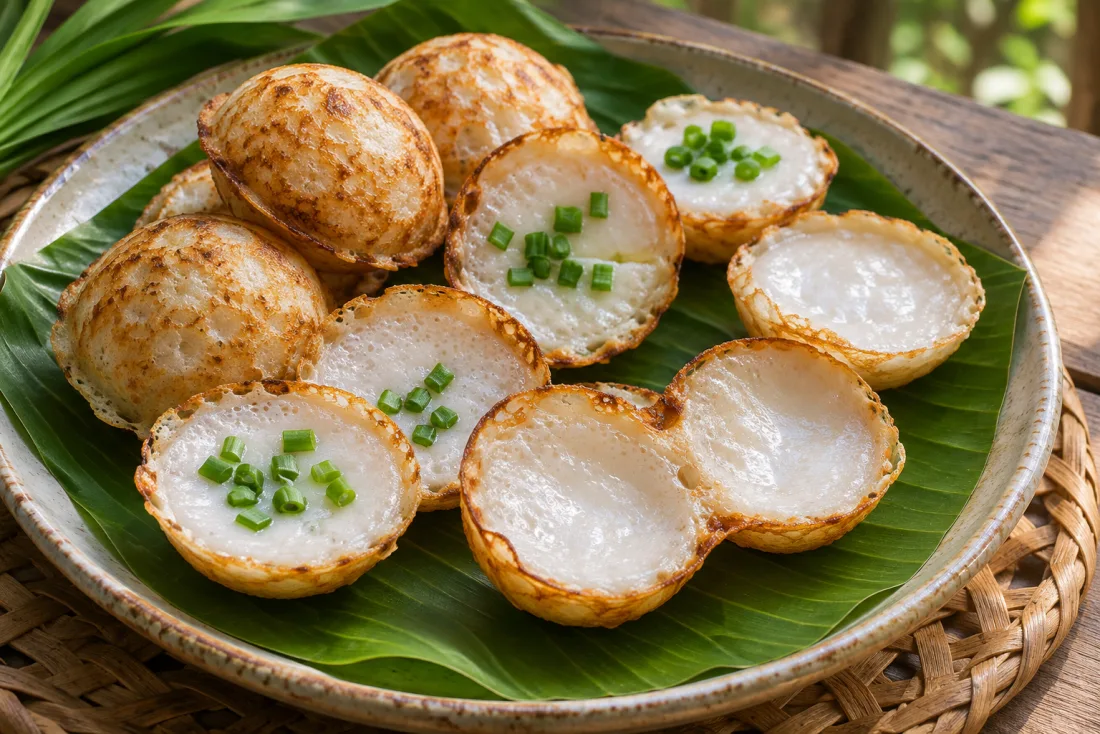

What these Thai snacks are and where you may see them
At a Thai snack stall you may see a pan full of little wells, each holding a white rice pancake beginning to turn golden around the rim. That is how kanom krok are often cooked. Kanom refers to a snack or sweet and krok usually refers to a mortar. Together the words name these little griddled rice cakes. Recipes and public demonstrations show their place among Thai street sweets, with no clear basis here for assigning their invention to one province.
If you have never tasted them, imagine a shallow edible cup. The underside browns like a griddled pancake, while the soft coconut filling sits inside.
How rice flour and coconut milk work in the two batters
Thai cook Pailin Chongchitnant makes one batter for the shell and another for the filling. Her shell uses regular rice flour, cooked jasmine rice, coconut milk, grated coconut, palm sugar and salt. The filling takes coconut milk, sugar, salt and a little rice flour. The rice mixture toasts into a thin shell and the coconut-heavy filling remains soft.
The recipe uses regular rice flour. Glutinous rice flour behaves differently. Palm sugar, grated coconut and cooked jasmine rice are features of this particular recipe. You can recognise the dish by the rice and coconut milk, while the sweetness and details vary by stall.
How a dimpled pan makes a crisp edge and a soft centre
The cook warms the pan, oils the shallow wells, pours in the shell batter, then adds the filling in the centre. The outside sets where it touches the hot pan. A lid traps heat long enough for the upper coconut layer to set. Corn or scallions can be added while the tops are still soft, and the cooked cakes are eased out with a spoon.
The two batters show in the cross-section: a thin rice shell below and a thicker, custard-like coconut layer above. Too much heat can darken the rim before the centre sets. A brief rest on a rack lets steam escape and keeps the edge crisp.
Flavour, texture and how to eat them
Warm kanom krok smell of coconut milk and toasted rice. A light sweetness gives way to salt in the filling. Fresh from the pan, the coconut layer is soft and pudding-like and the edge is thin and crisp. Both can soften as the cakes sit. Give them a moment before eating, since the filling can stay hot after the rim feels cool.
Try a plain one for the clearest coconut flavour. Sweet corn adds juicy sweetness, cooked taro is soft and starchy, and sliced scallions lend a green, slightly sharp note. Their savoury lift works with the sweet coconut base.
Choosing a topping and seeing how Thai rice becomes a sweet
A plain cake usually has an even white surface. On Thai menus, ข้าวโพด means corn, เผือก means taro and ต้นหอม means scallion. Ask what is available that day if the toppings look similar. A few scallion slices still sit on a sweet base, while corn usually comes as several kernels on top.
Thailand’s Ministry of Foreign Affairs documents kanom krok at a Thai rice afternoon tea in New York and in a cooking demonstration at the Thai embassy in Dakar. Watching the pan fill and the cakes set shows how Thai cooks turn rice and coconut milk into a bite-sized dessert.
Coconut, milk, wheat and shared equipment
Kanom krok usually contains coconut milk, and some shells also use grated coconut. If you have a coconut allergy, ask about coconut oil used on the pan as well. A rice-and-coconut-milk recipe can be made without dairy milk, eggs or wheat. Ask if the stall uses condensed milk, milk powder, butter, other flour or any additional ingredient in its own batter.
If an allergy is relevant, ask what is in both batters, what goes on top and how the wells are greased. The stall can also explain whether its pan, ladle, tongs or mixing bowls touch other products.
If you have a food allergy, tell the restaurant before ordering and ask about ingredients, sauces and shared cooking equipment.