
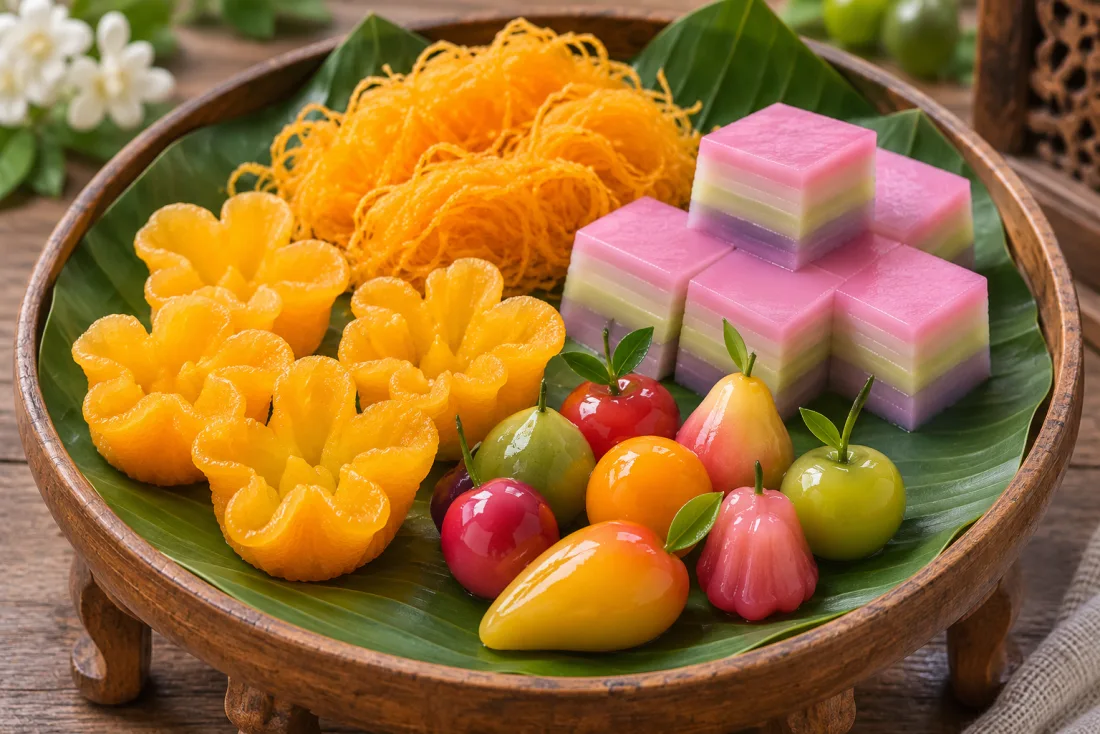

Identifying sweets by shape
Khanom chan has visible layers. Thong yip resembles a pleated yellow flower, thong yot a round drop and foi thong fine golden strands. Luk chup looks like tiny fruit. Tako is a coconut-topped pudding that can be served in a small leaf cup. Khanom thuai is a type of steamed coconut cup.
From market counters to celebrations
Thai historical cookbooks record many sweets using rice flour, coconut milk and palm sugar. Some kinds carry auspicious meanings at celebrations. A restaurant platter has no fixed set of pieces, and shops can also sell them individually.
Several techniques on one plate
Layer cakes are steamed a coat at a time. A tako cup can have a sago base with a slightly salty coconut topping. Khanom thuai has separately steamed layers. Egg confections cook in syrup. Luk chup is shaped mung bean paste with a clear agar coating.
Different kinds of sweetness
Steamed layers are pliable with a coconut or pandan aroma. Golden egg sweets taste richly syrupy. Mung bean paste is smooth beneath a thin springy coating. Unsweetened tea pairs with the richer pieces.
Ordering and sharing
Ask which sweets are included and choose a few different shapes. Cup sweets can be served separately. Keep syrupy pieces and softer cakes separated if packing the selection to go.
Allergens vary by piece
The golden egg confections contain egg. Coconut and mung bean appear in other pieces. Ask about wheat, milk, peanuts, tree nuts, sesame and shared utensils in any particular assortment.
If you have a food allergy, tell the restaurant before ordering and ask about ingredients, sauces and shared cooking equipment.