

 fish
The steamed curries of central Thailand
In Thailand’s Central Plains, fish, curry paste, coconut cream and eggs can be steamed in a banana leaf into a savory custard. A published Thai cookbook from 1929 records several proteins in steamed curry parcels, including fish. Hor mok, ho mok and haaw mohk are spellings of the same name, and pla means fish.
The Central Plains preparation is found beyond any one city. The Tourism Authority of Thailand documents steamed fish curry at Nong Mon Market in eastern Chon Buri and a bamboo-tube preparation in Phetchaburi. The central steamed curry tradition and these market versions help explain the dish’s presence in Thailand, while the name cannot identify its birthplace.
How the fish, curry, coconut and egg set
Fish can be finely chopped and stirred into curry paste, or some pieces can be left intact and layered through the mixture. Coconut cream contributes richness and egg helps the mixture set. Some recipes add a little rice flour. The fish varies by location or cook, with Thai recipes using fish such as barracuda and featherback for different textures.
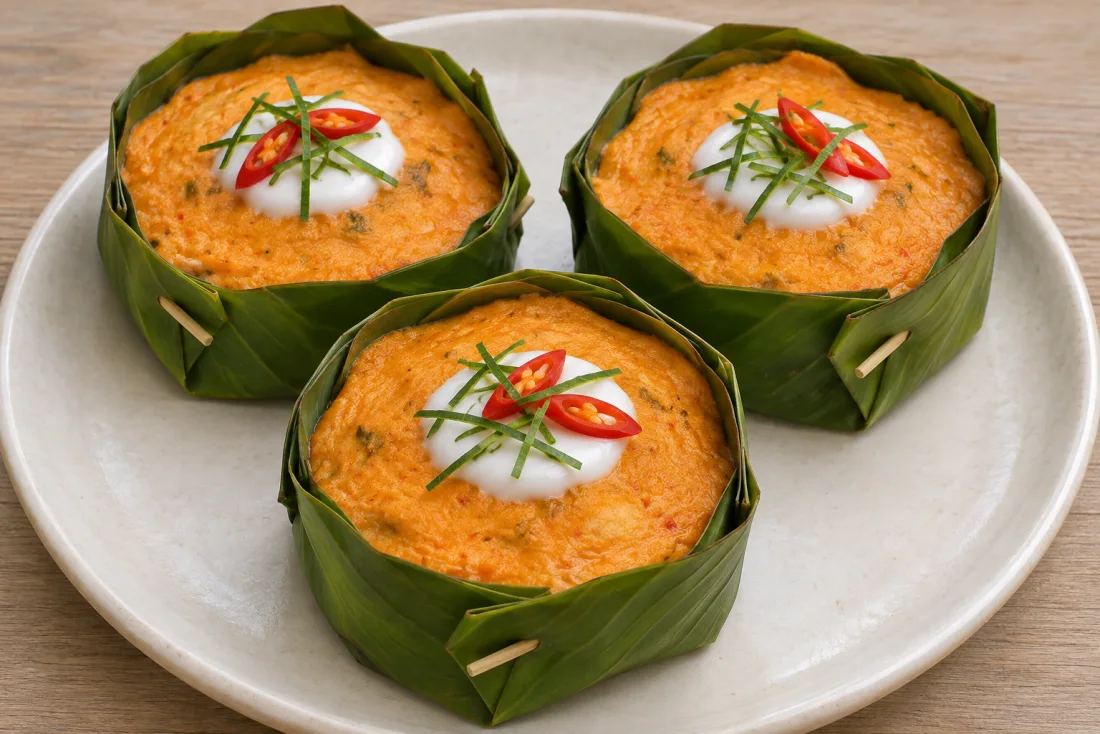
Banana leaves can form a small cup or a folded upright parcel. Blanched noni leaves or other edible greens can sit under the curry. After steaming, coconut cream may be spooned over the top, with finely sliced makrut lime leaves or red chilli. A spoon can pick up fish, custard, greens and garnish together.
A tender custard with curry aroma
Fish and egg set into a moist custard that holds together enough to scoop with a spoon. Coconut cream rounds out the curry paste. A coarser version gives distinct flakes or pieces of fish, while finely mixed fish makes a smoother custard. The greens at the bottom may have a firmer bite.
Curry paste, fish sauce and fish contribute savory notes, while coconut brings a gentle sweetness. Chilli levels can differ by kitchen. Ask about the heat of the curry itself even when a menu photo shows only a little red chilli on top. Removing the garnish leaves any chilli already mixed through the custard.
Market cups and steamed rice
A banana-leaf cup makes a small serving easy to buy or carry away. At Nong Mon Market in eastern Chon Buri, hor mok appears alongside seafood and other foods to take away. Thai cooks also serve it warm over plain rice, which takes up the coconut and curry. It can be one of several dishes shared at the table.
Scoop along the side of the leaf cup to get fish, greens and coconut cream in one bite. The banana leaf serves as the container. Unwrap a closed parcel before eating. Cup sizes vary, so ask how many come in a serving and whether rice is included.
Leaf cups, parcels, bamboo and seafood versions
An open cup shows the coconut topping, while a closed parcel is easy to carry. A bamboo tube is another container documented in Phetchaburi. Ngop is a related preparation cooked over a grill in banana leaves. It can bring smoky notes from the different method, so similar-looking parcels are worth asking about.
Hor mok thale generally signals mixed seafood and can include shrimp or squid. Even when a menu says pla, ask what kind of fish it is and about additional seafood. The preparation can range from a smooth custard to one with large fish pieces or a mixture of seafood.
Fish, egg and possible shrimp paste
Fish is the main ingredient and egg is often part of the custard. Fish sauce may season the mixture and some curry pastes contain shrimp paste. For mixed seafood versions, also ask about crustaceans or mollusks. The white topping is often coconut cream. Ask about added dairy or thickeners if relevant to your needs.
Ingredients are stirred through the custard, so cutting away a piece or removing the greens cannot take them out. Specify what you need to avoid, then ask about the curry paste, fish sauce, preparation and steamer. Steamer trays, knives and mixing containers can be shared with other seafood.
If you have a food allergy, tell the restaurant before ordering and ask about ingredients, sauces and shared cooking equipment.