

 fish sauce
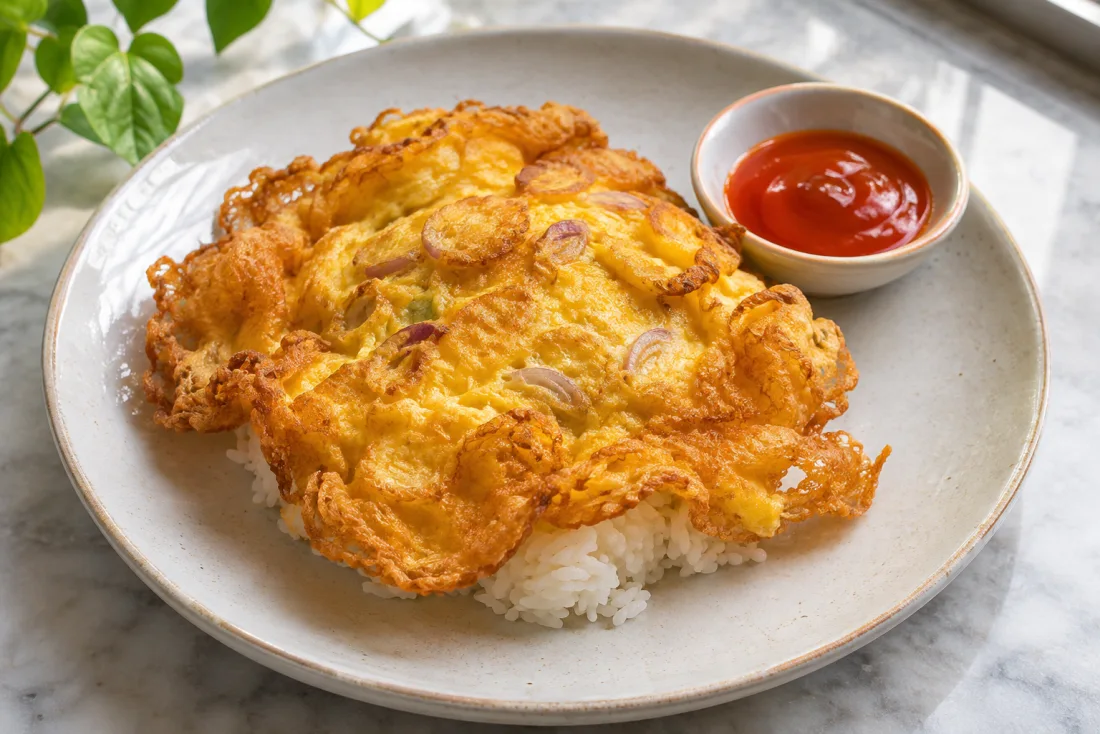
A Thai household omelette and rice plate
Kai means egg and jiao in this name describes frying beaten egg. Thai menus may use English spellings such as kai jeow or khai jiao. Thai cooks describe it as a household dish, and the Tourism Authority of Thailand documents eating a Thai omelette with rice in Nakhon Nayok.
A household can serve a plain omelette on a shared table, while a stall can put it over rice. These settings help place it in everyday Thai dining. The name alone does not identify where it was first made or what is in a particular version.
Beaten eggs, seasoning and hot oil
The plain version uses eggs, often a little fish sauce, and oil. Beating produces small bubbles, and the egg mixture spreads and puffs in hot oil. It cooks through, with different degrees of golden color on each side. The basic preparation does not require minced pork.
A smaller pan or more egg can make a thicker omelette. A cook looking for crisp edges can spread the mixture farther or distribute it through a strainer. One recipe adds a little lime to the egg. That is a recipe option.
Crisp edges and a tender center
The edges can be crisp and browned, while the thicker center tastes of egg. A little fish sauce gives it savory saltiness. Pan size, oil and the amount of egg can change the result from thin and crisp to thick and fluffy.
The plain omelette often emphasizes egg and salt. Sriracha adds acidity and heat. A household might serve a milder sauce or shrimp-paste dip. Try the egg first and then the sauce. Crab or minced pork changes the flavor and texture of the filling.
Serving it with rice, soup and other dishes
Putting the omelette over steamed rice makes khao kai jiao, where khao means rice. The rice picks up a little of the oil and carries the omelette’s savory flavor. At a family table the omelette can also be divided beside rice, clear soup and vegetables.
Try a crisp edge separately and eat the soft center with rice. At takeaway counters, sauce poured on the omelette can soften its surface. Ask if the sauce can be packed apart. Check whether the menu includes rice when portions are described separately. For a shared table, ask how large the omelette is or whether it and the rice are priced individually.
Recognizing pork, crab and fried-egg variations
Kai jiao moo sab contains minced pork, while kai jiao pu has crab. Cooks can mix the filling through the eggs or make a thicker roll. Ask what is in a plain version if you are avoiding an ingredient, since the mixture can be difficult to identify in a photo.
Kai dao is usually an egg cracked directly into the pan, with white and yolk visible. Kai jiao uses beaten egg and cooks as one golden piece. Hoi thot is a separate dish that often uses batter, shellfish and egg, giving it another kind of crust.
Allergies in the eggs, seasonings and fillings
Egg is used throughout. Fish sauce can contain fish, while soy sauce can contain soy and wheat. Oyster sauce can contain mollusks. Crab, shrimp and shrimp-paste dips introduce crustaceans. Check the seasoning used even if the menu describes the omelette as plain.
Ask separately about the egg mixture, dips, fillings, and shared tools or frying oil. Removing a dip does not remove ingredients already beaten into the eggs. The kitchen can confirm whether it can use separate oil, utensils and plates.
If you have a food allergy, tell the restaurant before ordering and ask about ingredients, sauces and shared cooking equipment.